

A Party Doesn’t Need Constant Action
There’s a natural temptation when planning a children’s birthday party to keep adding things. Another game, another activity, another attraction, another thing for the children to do whenever they appear to have a spare thirty seconds.
It sounds sensible on paper, but a party that’s packed from beginning to end can actually become exhausting. Children need opportunities to run around, but they also need moments where they can sit down, eat, chat and simply decide what they want to do.
The trick is finding a rhythm that keeps the afternoon interesting without making it feel like everyone is racing against a timetable.
Let the First Few Minutes Be Unstructured
Guests rarely arrive simultaneously. One child might turn up twenty minutes before another, while someone else is still being persuaded to leave the car.
There’s no need for the main entertainment to begin immediately.
Having a few simple things available gives early arrivals something to do while everyone settles in. A craft table, some toys, music or a small game can be enough. Once most of the guests have arrived, you can bring everyone together for the main part of the celebration.
Follow Energetic Moments With a Breather
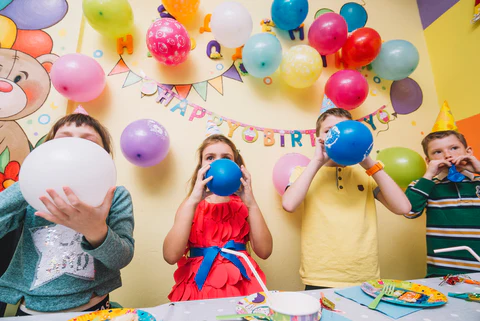
Children can go from sitting quietly to running around at maximum speed remarkably quickly. They can also go in the opposite direction just as suddenly.
Planning activities with different energy levels can help. A lively game might be followed by food. A performance could be followed by some free play. A noisy group activity might give way to something creative.
This doesn’t mean you need a detailed timetable. It simply means recognising that nobody, including the children, wants to operate at maximum volume for two straight hours.
Entertainment Should Support the Party
The role of entertainment isn’t necessarily to fill every empty moment.
Good kids party entertainment can provide a strong focal point during the afternoon while still leaving room for everything else that makes a birthday enjoyable. Children can become absorbed in an activity, then move on to food, games or their own play afterwards.
This also gives parents a little flexibility. If something takes longer than expected, there’s less pressure to squeeze the rest of the schedule into an increasingly tiny window.
Food Is Part of the Rhythm Too
Food is often treated as something that happens at a particular time because the party plan says so. In reality, it can be a useful transition between activities.
After an energetic game, sitting down for snacks gives everyone a chance to recover. Later, the cake can create another natural gathering point when everyone comes together to sing, make a wish and inevitably argue about who got the biggest slice.
It doesn’t need to be complicated. Food can simply help divide the afternoon into manageable chunks.
Leave Some Things Completely Unplanned
Children are remarkably good at creating their own entertainment when they’re given a little freedom.
They might invent a game using something that wasn’t intended as a toy, start dancing when music comes on or decide that the cardboard box from the decorations is suddenly the most exciting object in the room.
Those moments shouldn’t necessarily be interrupted.
If everyone is happily playing together, there is no urgent reason to announce the next activity just because it was written on the original plan.
Watch the Children, Not the Clock
A party schedule is useful, but the children themselves are a much better indicator of whether it’s time to move on.
If everyone is losing interest, change the activity. If they’re having a brilliant time, let it continue. If they’re getting tired, give them something quieter to do.
This sounds obvious, yet it’s surprisingly easy to become focused on keeping the planned schedule intact.
The Ending Doesn’t Need to Be Grand
The final part of a party can be fairly simple. Cake, a last game, some music or a small activity can provide a natural wind-down before parents begin arriving.
In fact, ending on a calmer note can be preferable to trying to finish with the biggest and loudest activity of the afternoon. Children have already had their excitement; now they’re heading home with stories to tell.
A great birthday isn’t measured by how much you managed to squeeze into it. It’s about whether the different parts worked together, whether the children had room to enjoy themselves and whether the afternoon felt enjoyable rather than rushed.
Sometimes the best party plan is the one that leaves just enough space for something unexpected to happen.