You can spend a weekend planting new shrubs and still have your house look… tired. Or you can pressure wash, and suddenly the place looks like it’s been “taken care of.” It’s not glamorous. It’s not Pinterest-core. It works.
One caveat up front: pressure washing isn’t “blast everything at max PSI and call it cleaning.” That’s how people carve tiger stripes into concrete and fuzz up their deck boards.
A clean exterior reads as maintenance, not decoration.
What are you trying to fix, exactly?
Here’s the thing: “curb appeal” is vague. Dirt isn’t. Algae isn’t. Rust stains aren’t.
Walk to the street, turn around, and *actually look* at your place like a stranger would. In my experience, most homes only need two or three zones cleaned to get 80% of the visual payoff. If you’re not sure where to start, this guide on Where Should You Pressure Wash Your Property? can help you prioritize the areas that make the biggest difference.
Quick curb-appeal targets (high impact):
– Driveway and front walk: oil drips, tire marks, dingy film
– Front-facing siding: algae on the shady side, spider webs under eaves
– Porch/deck steps: green slickness (also a slip hazard)
– Fence sections near sprinklers: mildew line, overspray stains
Now, this won’t apply to everyone, but if you’re dealing with flaking paint, older mortar, or soft brick, the goal changes from “bright white again” to “cleaner without wrecking it.”
Set a measurable win: *remove visible algae*, *lighten the concrete one shade*, *restore the original wood tone without scoring it*. If you can’t define success, you’ll overwash and damage something.
Gear talk (and a little opinion)
Bold opinion: most homeowners buy too much pressure washer and not enough nozzle discipline.
For typical home use, you’re balancing two specs:
– PSI (pressure): how hard it hits
– GPM (flow): how fast it rinses and clears grime
Higher GPM often cleans faster than chasing extreme PSI, because you’re flushing dirt away instead of sandblasting it.
A quick technical guide:
– Electric units (often ~1,500, 2,000 PSI) are plenty for cars, patio furniture, small patios, many siding situations if you use detergent and patience.
– Gas units (commonly ~2,500, 3,500 PSI) are better for big concrete runs and heavy grime, but they’ll also damage wood and siding fast if your technique is sloppy.
Look for:
– Adjustable/quick-change nozzles (you’ll use them constantly)
– A hose long enough that you’re not dragging the machine like a stubborn pet
– Downstream detergent capability if you want easier siding/deck cleaning
Safety features are nice, but the real “safety feature” is your restraint.
A data point for context: the U.S. Consumer Product Safety Commission has long tracked thousands of pressure-washer related ER visits in the U.S. annually, many involving lacerations and eye injuries (CPSC injury estimates via NEISS; see CPSC NEISS documentation at cpsc.gov). Wear eye protection. Every time. No exceptions.
Prep: the part people skip, then regret
Look, you can pressure wash without prep. You can also paint without taping. You’ll “finish,” sure.
Start with a five-minute scan:
– Open windows? Close them.
– Outdoor outlets nearby? Cover them.
– Loose siding, cracked caulk, wobbly trim? Note it and avoid direct spray.
– Plants in the line of fire? Move or cover them.
I’ve seen landscaping get chemically cooked not from pressure, but from detergent runoff and hot sun. If you’re using any cleaner at all, wet plants first (plain water), cover sensitive ones, and rinse again afterward. Water dilutes and protects. Plastic alone can trap heat and fry leaves (especially if the sun’s blasting).
Pets and kids don’t mix with pressure washing. Keep them inside. A ricocheted pebble at 2,800 PSI is a bad day.
One-line truth: Prep is cheaper than repairs.
The actual washing, but in real-world order
Most people start where they *want* to see results. I start where gravity and runoff won’t sabotage me.
#Concrete: driveways, walks, pavers
Concrete can take more pressure than your house, but it’s not invincible. Get too close and you etch it permanently.
Technique that keeps you out of trouble:
– Use a wider fan tip, not a zero-degree needle jet.
– Keep the wand moving, always.
– Work in manageable strips (think 3, 4 feet wide), overlap passes.
If there’s detergent involved, apply it, let it dwell briefly (don’t let it dry), then rinse from the high side down so dirty water doesn’t streak across finished sections.
Oil stains? Don’t expect miracles. Degreasers help, and repeated treatments beat one aggressive blasting session.
Siding (the “don’t get cocky” zone)
Vinyl and fiber cement are forgiving. Painted wood and older surfaces are not.
The big mistake is forcing water behind siding or into seams. Aim the spray downward. Avoid shooting upward under laps. If you can’t keep the spray angle controlled from the ground, don’t climb a ladder with a pressure wand. Use an extension wand or hire it out.
Detergent does the heavy lifting here. Pressure is mostly for rinsing.
And yes, you’ll get better results with a soft-wash approach (lower pressure + appropriate cleaner) than with brute force.
Decks: treat wood like it has feelings
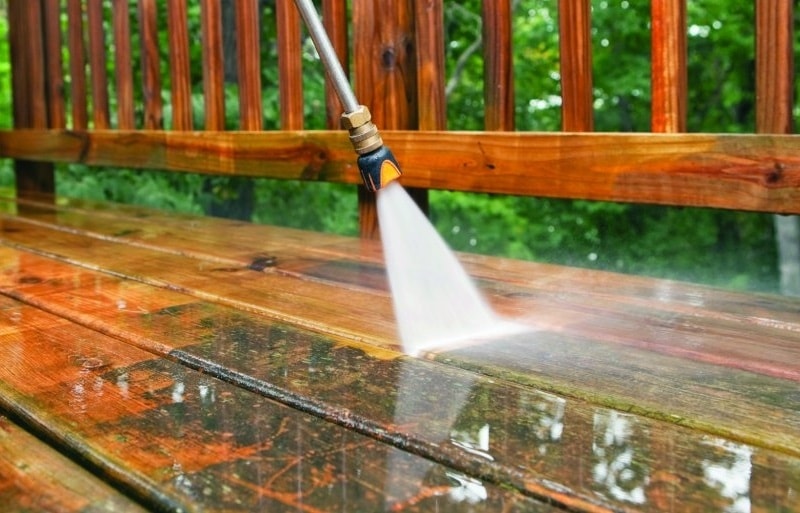
Deck boards get chewed up when you use too much pressure or a tight tip. That “fuzzy” surface isn’t dirt lifting. It’s wood fibers being shredded.
Use a deck cleaner, let it work, then rinse gently with a wide fan. If algae is stubborn, a light scrub beats dialing up PSI. I know it’s less satisfying, but it keeps the boards intact.
Fences, brick, stucco: case-by-case
– Painted fences: gentle, test first, watch for peeling.
– Brick: sound brick is usually fine; old mortar isn’t. Keep distance.
– Stucco: easy to damage. Go low pressure and rely on detergent.
If you’re tempted to “just hit it harder,” stop. That instinct costs money.
Common mistakes I see constantly (and how to not be that person)
Some are obvious. People still do them.
Setup blunders
– Running a kinked hose (you’ll stress the pump)
– Using the wrong nozzle because “it came installed”
– Ignoring leaks until something blows off under pressure
– Skipping a test patch and discovering too late you’re etching paint
Technique traps
– Holding the spray in one spot to “finish it off” (that’s how you gouge)
– Standing too close for speed (speed comes from methodical passes, not proximity)
– Spraying upward at siding laps and trim
– Washing on a windy day and coating windows, lights, and the neighbor’s car in grime mist
Wear shoes with grip. Wet concrete is slick. Add detergent and it’s basically an ice rink.
Saving money long-term (without turning it into a hobby)
Pressure washing is cheap if you treat it like maintenance, not a once-every-five-years rescue mission.
A few practices that keep costs down:
– Clean lightly more often instead of doing one brutal deep clean
– Dilute concentrates correctly (more soap isn’t more clean)
– Rinse thoroughly so you don’t leave residue that attracts dirt
– Store the machine properly; pumps hate freezing temps and leftover water
If you clean porous surfaces (concrete, pavers, some stone), consider sealing after everything dries. Sealer isn’t magic, but it slows down future staining so each wash gets easier.
And yeah, write down what worked. Nozzle choice, detergent mix, dwell time. Next year you’ll thank you.
Final thought (not a pep talk)
Pressure washing rewards patience. The best-looking jobs aren’t the loudest or the fastest. They’re the ones where you used the least pressure necessary and still got the surface genuinely clean. That’s the trick, and once you get it, curb appeal gets weirdly easy.

